
A viral claim keeps making the rounds: that a 1% advisory fee will drain hundreds of thousands of dollars from your retirement savings.
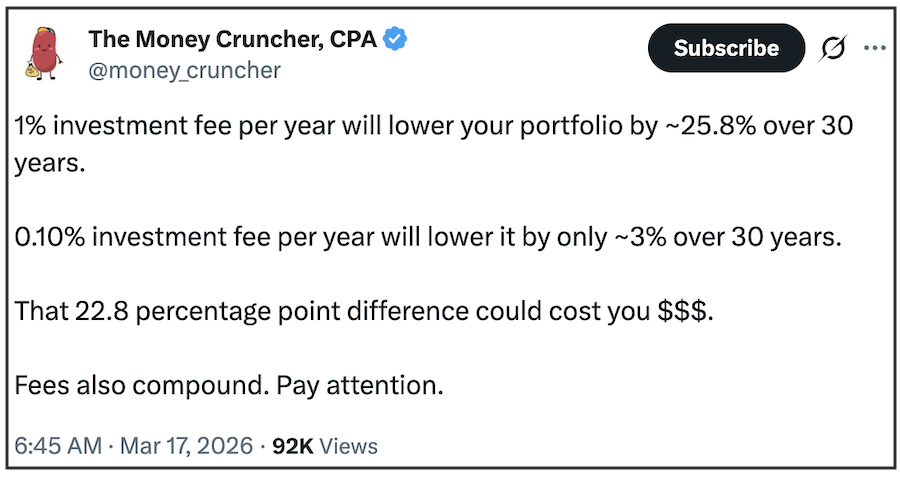
The math looks alarming… and that’s exactly the point.
But as with most things in finance (and life!), the truth is more nuanced than a headline or social media post makes it seem.
In this episode, I break down research from Derek Tharp, Ph.D., CFP®, that puts this widely shared math to the test and reveals where it falls apart.
Here’s what you’ll learn:
- The misleading assumptions behind the popular “1% fee” calculation
- How alternative fee models can be 3x more expensive using the same math
- What academic research says about quantifying the value of a good advisor
- A smarter way to evaluate whether hiring an advisor makes sense for your specific situation
This episode isn’t about defending any particular fee model.
It’s about making sure you have the right information to evaluate the cost, the value, and the role financial advice may play in your retirement planning.
Listen To This Episode On:
When You’re Ready, Here Are 3 Ways I Can Help You:
- Schedule a Free Retirement Strategy Session. Get your questions answered + learn how we can help you improve retirement success and lower taxes.
- Listen to the Stay Wealthy Retirement Show. An Apple Top 50 investing podcast.
- Join My Retirement Newsletter. Weekly retirement and investing tips (delivered to our inbox!)
+ Episode Resources
- Derek Tharp: Quantifying (More Accurately) The Real Impact Of A Financial Advisor’s Costs On Their Clients’ Nest Eggs
- Guiding Clients To Design Their Rich Life With A Focus On Spending Dials Not Goals (With Ramit Sethi)
- Academic Studies Quantifying the Value of Financial Advice:
- 5-Part Financial Advisor Series:
+ Episode Transcript
Last month, a listener sent me a screenshot from social media.
It was one of those viral posts you see every few weeks, where a financial influencer (or sometimes advisor) runs a simple calculation showing how much a 1% advisory fee supposedly costs over your lifetime. In this particular case, the numbers were eye-popping. Hundreds of thousands of dollars. A massive chunk of your retirement nest egg. Gone. Just like that.
And the takeaway was clear: most financial advisors are ripping you off, and you’d be better served going it alone or using a low-cost, discount advisory service.
Now, to be extra clear, fees do matter. They matter a lot. And there’s no denying that this profession has its share of advisors who charge too much and deliver too little.
But here’s the problem with these viral claims and fee comparisons: the math isn’t necessarily wrong, the framing is just deeply misleading. Because when you apply that same math to other expenses in life, the results get absurd pretty quickly and the logic starts to fall apart.
How absurd? Well, according to one researcher, a single trip to Disney World when you were five years old cost you 7% of your retirement nest egg. Your daily coffee habit? About 27%. And the cost of your parents feeding you as a child? Nearly 37%.
I know, it sounds ridiculous, and that’s exactly the point.
So, today on the show, I’m breaking down a very thoughtful piece of research from Derek Tharp, a PHD who is the lead researcher at Kitces.com and an associate professor of finance at the University of Southern Maine. Derek took this widely referenced anti-advisor math, stress-tested it, and showed why it falls apart when you examine it more closely.
In addition to walking through Derek’s findings, I’m also sharing what the broader academic research actually says about the value of good financial advice and how consumers should think about evaluating the cost of hiring a professional.
Welcome to another episode of the Stay Wealthy Retirement Show. I’m your host, Taylor Schulte, and every week I cover the most important financial topics to help you “stay wealthy” in retirement. Ok, onto today’s episode.
The Real Cost of a Financial Advisor (And Why the 1% Math Is Misleading)
Ok, before we dive into this often controversial topic that really shouldn’t be controversial, I want to get ahead of any potential misconceptions about the purpose of this episode.
As most listeners know, I own and operate a retirement and tax planning firm. On our website, it’s clear and transparent that we have a minimum annual fee, and the exact fee we propose depends on the scope of work, complexity, and a client’s unique situation.
The agreed upon fee can be billed either as a percentage of the investments we manage or as a flat annual dollar amount adjusted for inflation each year. The amount and billing method (flat annual fee or percentage) is ultimately based on discussions with the client and what makes the most sense for their situation.
I’m sharing this because I want to be clear that I am not publishing today’s episode to defend a particular fee model. That’s not of interest to me. There is no one-size-fits all answer and there are very clear pros and cons to every compensation model. What I do care deeply about is that fees charged by financial professionals are transparent, properly aligned with the value being delivered, and that consumers have the information they need to make an informed decision. If you want to go deeper on the different types of financial advisors, the different fee models, and the pros and cons of each, I published a 4-part series on this topic a few years ago. I’ll link to it in today’s show notes if you’re interested, which can be found by going to youstaywealthy.com/278.
Ok, with that out of the way, let’s clear up some of the misleading math that continues to circulate around the internet.
If you’ve spent any time in online personal finance communities, you’ve probably come across Ramit Sethi. He’s a bestselling author, he had a Netflix show, and he has a pretty massive following. And one of his go-to talking points is that paying a 1% fee to a financial advisor for their services is a terrible deal.
Now, to be fair, I don’t completely disagree with Ramit’s opinion here. This industry has its fair share of financial salespeople out there disguised as comprehensive planners who deliver very little, if any, actual financial planning services. And consumers should absolutely be mindful of what they’re paying and what they’re getting in return.
But the way Ramit, and many others who blindly follow his lead, calculate the cost of a financial advisor is where things go sideways, and that’s exactly what Derek Tharp digs into in his research.
Here’s how Ramit’s calculation typically works.
He takes two identical portfolios. One portfolio is managed by an advisor who charges a 1% Assets Under Management fee. The other is managed by a do-it-yourself investor with no advisor fee. He then runs both portfolios forward for 35 years, assumes they experience the same exact rate of return, and then compares the ending balances. The difference between those two balances is what he labels as the “cost” of the advisor. In one of his examples, the gap comes out to over $380,000, and it’s followed up by saying something like, “that’s 28% of your lifetime returns going into your advisor’s pocket.”
I get it. That sounds alarming. And it’s designed to sound alarming. But as Derek points out in his article, the person in that example did not actually pay their advisor $380,000. The actual cumulative fees paid over those 35 years were closer to $167,000, spread out over the entire period. Which means that the average fee paid was actually less than $5,000 per year.
So, where does the $380,000 number come from? Well, it comes from taking each annual fee that was paid and inflating it forward at the full assumed market rate of return. In other words, he isn’t just showing you what you paid, he’s also including and showing you what those fees could have hypothetically grown into if they’d been invested in the market instead. And that’s the sleight of hand here. Technically, the math is not wrong, but it creates a wildly distorted picture of the actual expense. So let’s go and ahead and further unpack how that calculation actually works—and why it can often lead people to the wrong conclusion
In the research, there is a hypothetical person named Sarah who saved diligently over a 40 year time period and built a $1 million nest egg by age 65.
Using the misleading math, a 1% advisory fee over that same period consumed about 25% of Sarah’s retirement nest egg. Sounds pretty bad, until Derek applies the exact same method to other things Sarah spent money on during her lifetime. And this is where it starts to get fun.
Sarah’s diapers as a baby? Using Ramit’s math, where every dollar is compounded at stock market returns, those diapers ended up “costing” her roughly 10.5% of her retirement portfolio. The cost of her parents feeding her from birth to age 18? Almost 37% of her nest egg. A family trip to Disneyworld when she was five? 7%. Buying a modest Honda Civic every 10 years? Nearly 45% her nest egg. A daily latte habit from age 25 to 65 ended up costing her 27% of her retirement savings.
In other words, this methodology suggests that a daily cup of coffee consumed roughly the same percentage of Sarah’s retirement as a financial advisor did.
And here’s the kicker. If you add up just that short list of everyday expenses using Ramit’s method, you blow right past 100% of Sarah’s retirement nest egg, which makes sense, because Sarah, like most people, saves only a fraction of her income and lives off the rest. So by this logic, simply living your life is costing you 900% of your retirement nest egg every single year.
It’s pretty absurd, and that’s Derek’s point. Inflating past expenses at stock market returns and then expressing them as a percentage of your nest egg is not a reasonable way to evaluate any expense, whether it’s diapers, coffee, or a financial advisor.
Now, Derek also runs another comparison that I found particularly interesting, and this one involves one of the models that Ramit often endorses as an alternative. For context, Ramit maintains a paid endorsement relationship with a company called Facet Wealth, which at the time Derek’s article was published, charged an ongoing annual subscription fee ranging from $2,000 to $6,000 per year.
So, to highlight another issue with this misleading math, Derek took that same hypothetical scenario with Sarah and compared the cost of a 1% advisory fee against Facet’s annual subscription model using the exact same methodology Ramit uses.
Here’s what he found. At Facet’s lower end of $2,000 per year, the long-term cost using Ramit’s method came out to 23% of Sarah’s retirement nest egg. If you’re following along, yes, that’s almost identical to the advisor who charged a 1% fee.
And at Facet’s higher end of $6,000 per year? The cost ballooned to 70% of Sarah’s retirement nest egg.
Said another way, the flat-fee model that Ramit endorses and gets paid to promote can actually end up being more 3x more expensive than the fee model he criticizes, depending on the price tier, using his own math.
Now, to be extra clear, Derek isn’t arguing that any of these numbers are a sensible way to evaluate costs—he’s showing us that Ramit’s methodology is flawed no matter which fee model you apply it to. And that when you use it consistently, the % of assets fee model and the flat-fee model end up in roughly the same ballpark, or in some cases, the % of assets model can even come out ahead.
Ok, so if inflating fees at market returns isn’t the right way to think about this, what is? Well, the even bigger problem with this misleading math being used by Ramit and a growing number of financial advisors, coaches, and influencers, is the assumption that zero value is received in exchange for the fees paid. Yes, zero. The zero value assumption is baked right into the calculation. Two identical portfolios are being compared, one with fees and one without, and the conclusion is that the person paying the advisor is just worse off.
But that only holds up if the advisor did absolutely nothing of value over those 35 years. No tax planning. No behavioral coaching during a market crash. No retirement income strategy. No Roth conversion optimization. No portfolio implementation and rebalancing. No estate or insurance planning. Nothing.
To me, that’s an incredibly unrealistic assumption for anyone working with an experienced, competent advisor who actually delivers comprehensive financial planning services.
While it’s certainly not a straightforward calculation, several major studies have tried to quantify the value of a good financial advisor. Vanguard’s research on the topic, often referred to as the Advisor Alpha study which I’ll link to in the show notes, estimates the value of an advisor at up to 3% per year or more. Morningstar’s research, called Gamma, came to a similar range. And Envestnet’s study, known as Sigma, estimated the total value add at roughly 3% as well. And yes, it seems as though the finance world ran out of creative names and just started working their way through the Greek alphabet. But the letters do have meaning — alpha is a nod to excess returns, gamma signals a different source of value beyond investment picking, and sigma represents the total sum of everything an advisor brings to the table.
So where does that value come from? Well, there are of course many areas where a good advisor can add value, and no two clients are going to benefit in the exact same way, but across all three studies, a few key areas consistently rise to the top.
The first is behavioral coaching, which has been estimated to be worth up to 2% or more per year in value on its own. And behavioral coaching isn’t just about talking someone off the ledge during a market crash, although that’s certainly part of it. It’s also about preventing someone from chasing the next investment fad, keeping someone from making a drastic portfolio change based on a headline or “expert prediction”, and perhaps most relevant to our listeners, helping retirees actually spend the money they’ve worked so hard to save. As I’ve discussed in recent episodes, underspending in retirement is a real and common problem,and sometimes, the most valuable thing an advisor can do is give someone permission and confidence to enjoy the wealth they’ve built. In that sense, a good retirement planner can actually cost someone more than the fee they pay, because the true value is helping them use their money instead of unnecessarily holding back.
The next most common area in each of the studies was tax management, which can be worth another 1% or more depending on the client’s situation. This naturally includes strategies like tax-loss or tax gain harvesting, asset location, Roth conversion planning, charitable giving strategies, tax bracket management, and more.
And then there’s the broader financial planning work that consistently surfaced in each study and added to the advisor value calculation. Withdrawal sequencing, spending strategies, Social Security optimization, estate planning coordination, insurance optimization.
Now, I want to clearly acknowledge that not everyone will receive the same value from every advisor. Someone who is an experienced do-it-yourself investor, enjoys managing their own portfolio, has the temperament to stay disciplined, and is comfortable handling tax and retirement planning on their own may not benefit much from hiring one. And yes, there are absolutely advisors out there charging 1% or more who do little beyond basic investment management. But for most people—especially those approaching or living in retirement, when decisions become far more complex—the research suggests that good financial planning can deliver value well in excess of a 1% advisory fee.
And I think there’s something else worth mentioning here that often gets lost in the fee debate: the value of the ongoing relationship. Ramit has historically encouraged people to work with advisors on an hourly or one-time basis as a way to cut costs. The idea being, get a plan, execute it yourself, and save the ongoing fees.
But many of the most valuable things an advisor does, like behavioral coaching during a market downturn, spotting a time-sensitive tax planning opportunity, or catching an unusual financial pattern that might indicate elder abuse, these things can only happen in the context of an ongoing relationship.
Nobody knows when the next market downturn is going to happen or when you will experience a major life event that requires professional help. And the moment you most need an advisor to talk you off the ledge or help you through a difficult time is not typically the moment you’re going to go searching for someone new on a one-time hourly basis.
Likewise, tax planning opportunities are often transient. Maybe a special situation comes up, a business loss or charitable gift that can be paired with a Roth conversion, or a one-time capital gains event that creates a unique harvesting opportunity. A good, proactive advisor who already knows your full picture can spot those things in real time. It’s not as easy for someone who is seeing your situation for the first time in a one-off engagement.
Derek also raises a practical point about the types of advisors that Ramit’s advice pushes people toward. In general, advisors who are great at what they do tend to gravitate toward ongoing relationship models over time. As they gain experience and build their client base, they drop hourly and project-based work because they recognize that they can deliver more value in a deeper, ongoing relationship. Said another way, the very advisors who are most likely to provide the greatest value are often the ones who don’t offer a one-time or limited-term engagement model.
I’m not saying hourly or project-based advisors are bad—I refer clients who don’t need or want a full-service relationship to a few trusted ones nearly every week. But it’s worth understanding that by filtering only for one-time engagements, you may be unintentionally screening out some of the most experienced planners who have the specialization and expertise to help with your exact pain points.
Now, does all of this mean that you should just blindly pay a 1% advisory fee and not think about it? Of course not. Consumers should absolutely be thoughtful about costs. And I think Derek offered a really smart framework for how to evaluate whether an advisor is worth it for your specific situation.
To start, look at the areas where research suggests advisors add the most value: tax planning, behavioral coaching, withdrawal strategies, estate and insurance planning, portfolio management, and more.
Then ask yourself, honestly: Where do I truly need help? Where am I strong? Where am I most likely to make a costly mistake? And what’s taking up time, energy, or mental bandwidth that I’d rather spend enjoying the things that matter most in retirement?
If you’re someone who has a history of getting uncomfortable during market downturns and making emotional changes to your portfolio, the behavioral coaching alone could be worth several multiples of a 1% fee.
If you’re heading into retirement and you have a complicated tax picture, with pre-tax IRAs, Roth accounts, taxable accounts, Social Security timing decisions, and potential Roth conversion opportunities, that’s an area where professional guidance can save you significant money over your lifetime.
And beyond the dollars and cents, there’s also the value of freeing up your time, energy, and mental bandwidth. If handling all of this on your own is creating stress, draining attention, or keeping you focused on spreadsheets instead of the people and experiences that matter most, that benefit is real too.
On the other hand, if you’re a seasoned investor who genuinely enjoys managing your own portfolio, has a solid financial plan, and isn’t easily rattled by market volatility, you may not need to pay for ongoing advice, or any advice at all. And that’s perfectly understandable. The key is to be honest with yourself about where you actually are, not where you think you should be.
One more thing before we wrap up. If you’re not already familiar with Michael Kitces, he holds two Master’s degrees, eight professional designations including the CFP®, was ranked as the #1 financial advisor by Investopedia multiple years running, and is widely regarded as the foremost deep thinker and educator in the financial planning profession. He also co-founded a support platform that helps launch flat-fee subscription-based financial advisors.
Michael interviewed Ramit Sethi a few years ago and there’s an interesting point in the conversation where Ramit puts Kitces on the spot and asks him whether he would allow his own parents to pay a 1% advisory fee to a financial advisor.
Here’s the clip:
Ramit: Here’s another ethical barometer. What would you want your mom or dad to pay their advisor?
Michael: Well, mine literally pay an advisor 1%.
Ramit: Why do you let them do that?
Michael: Because for them, it is an ongoing relationship. They’re at a point in the stage where…my folks are retired and moving on to later years. Re-explaining their financial situation to a new advisor every year isn’t going to work in the long run. In fact, in some number of years, I don’t even know how strong they’ll be to make a lot of their own financial decisions. And so, they can’t get a new financial advisor up to speed in meeting every year, the value for them is they have an ongoing relationship with someone who understands their whole situation and can deal with all of that on an ongoing basis.
I sort of think of it like when people have a lot of health issues, there comes a point where I don’t want to just go see a doctor every time I’m ill, I got a complex health issue, I want a dedicated doctor who knows my whole situation so I don’t have to explain the whole chart over and over again every single time. There’s a whole concierge medicine domain that’s growing in the same area. And when I look at it, even from the industry perspective, we put out some of the benchmarking numbers to calculate this. If I take the average amount of revenue that an advisor gets paid for the number of clients they have, and then I add up how many hours they actually spend servicing their clients, because we do some time-tracking studies around it as well, it comes out to be about $250 to $300 an hour on average.
Obviously, there’s a range. But the average advisors, AUM fees divided by the average number of hours the advisor services their clients, you end up at about $250-$300 an hour. Now, you’re buying larger chunks, you don’t get a one-hour engagement with an AUM advisor, it’s a relationship-based model clearly. But hourly rates end up competitive to what we see a lot of other advisors. Even when we do this with top-producing advisors, we still end up with numbers that are like $600 to $650 an hour. And people with 20-30 years of experience, they can command that more power to them.
Ramit: Well, I will say this. It sounds like I’ve come down pretty hard on AUM advisors.
I think Michael’s response says a lot. Even someone deeply immersed in the alternative-fee-model space recognizes that, for many thoughtful, educated people, a good and competent advisor charging a percentage-based fee—or even a flat fee that’s several times higher than a discount service like Facet Wealth—can still deliver enough value to more than justify the cost.
If you want to listen to the full conversation, I’ll provide a link to it in this episode’s show notes. But, at the end of the day, this isn’t about 1% fees vs. flat fees vs. hourly fees. It’s about finding the right advisor who provides real, tangible value for your specific situation, and then evaluating whether the cost of that advice is reasonable given what you’re receiving in return.
The viral social media posts and marketing material make it seem like the math is simple. But retirement planning isn’t simple. And the decisions you make around taxes, income, investments, and legacy are all interconnected.
So if you see one of those viral posts about the cost of a 1% advisory fee, just remember: the same math says your diapers cost you 10% of your retirement and a family trip to Disneyworld cost you 7%. The math isn’t wrong, but I don’t think its the most appropriate way to make decisions about something as important as your financial future.
Derek Tharp’s full article is linked in today’s show notes, and it’s well worth reading if you want to dig deeper into the numbers. I’d also encourage you to check out the studies from Vanguard, Morningstar, and Envestnet that attempt to quantify the value of financial advice. I’ll provide links to those as well.
Thank you, as always for listening, and once again, to view the research and all of the resources and articles supporting today’s episode, just head over to youstaywealthy.com/278
Disclaimer
This podcast is for informational and entertainment purposes only, and should not be relied upon as a basis for investment decisions. This podcast is not engaged in rendering legal, financial, or other professional services.